
Regular script · Glyph · Published 2026-08-25 · By The Lettering Desk
永字八法: eight brush actions hidden inside a five-stroke character
永 has five strokes and, by the classical count, eight methods. The mismatch is the point: three of the five strokes change action partway through, and those changes are what the eight names describe. Learning 永 is not learning a character, it is learning a checklist that applies to every character you will ever write.
- Glyph
- 永 — Yǒng zì bā fǎ — the eight principles of 永
- Hand
- Regular script
- x-height
- —
- Nib / brush angle
- 八法各有入笔角度,逐条列在分节中
- Tool
- 兼毫中楷,锋径 6 mm
- Stroke order
- 侧(点) → 勒·努·趯(横折钩) → 策·掠(横撇) → 啄(短撇) → 磔(捺)(5 strokes)
Stroke sequence
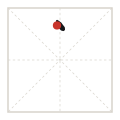
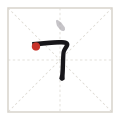
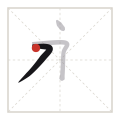
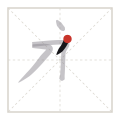
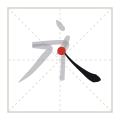
The eight names and where they live in 永
| Method | Character | Stroke in 永 | Action |
|---|---|---|---|
| 侧 cè | 侧 | 1 — the top dot | set the tip down sideways, the shape falls like a bird turning |
| 勒 lè | 勒 | 2 — the short horizontal | draw the rein tight: short, dry, slightly rising |
| 努 nǔ | 努 | 2 — the descent after the fold | the bow under tension: straight in intent, slightly convex in fact |
| 趯 tì | 趯 | 2 — the closing kick | release upward-left, tipped with a sharp point |
| 策 cè | 策 | 3 — the short rise | the whip: a fast, light crossing stroke |
| 掠 lüè | 掠 | 3 — the long left sweep | sweep down-left, power carried all the way into the tip |
| 啄 zhuó | 啄 | 4 — the short left stroke | a peck — abrupt, short, no hesitation |
| 磔 zhé | 磔 | 5 — the right-falling stroke | press the foot flat and open it out to the right |
Why 永 and not some other character
Every basic direction of travel appears in 永 at least once, and every one of them is paired with a change of pressure. That combination — direction plus pressure — is the full vocabulary of the brush. Characters with more strokes add repetition, not new actions.
It is also, usefully, a character whose five strokes are simple enough to repeat twenty times on one sheet without fatigue. Most traditional teaching sequences use 永 for exactly that reason.
Reading 永 as a checklist
The practical use of the eight methods is diagnostic. When a character fails, name the failure with one of the eight words and the repair usually becomes obvious: 勒 that has gone slack means the horizontal is too long; 努 without tension means the vertical bellies to one side; 磔 that is missing its foot means nothing in the character is pressed.
Notice that three of the eight describe strokes that carry two actions: 勒 → 努 → 趯 inside one continuous 横折钩, and 策 → 掠 inside one 横撇. Those two joints are where beginners lose control, so spend two thirds of your practice time on them and one third on the remaining six methods combined.
Order of practice
- Write the 横折钩 alone, twenty times, listening for the moment the brush decelerates before the 趯.
- Write the 横撇 alone, twenty times, keeping the fold round — a corner here destroys the whole character.
- Write 永 complete, slowly, six times, then at speed six times; the speed version shows which joint you have actually learned.
- Finish by writing 水 beside 永 and comparing the two verticals; 永's is a 横折钩 and must therefore be a touch shorter.

Printable A4, drawn to the worksheet specification — print at 100 % and check one cell with a ruler.
Takeaways
- Five strokes, eight methods — the extra three are the mid-stroke changes of action.
- 勒/努/趯 share one stroke; 策/掠 share another. Those joints are the hard part.
- Use the eight names as a diagnostic vocabulary, not as poetry.
- 永 is a scale model of the brush's whole vocabulary: direction plus pressure.