
Regular script · Glyph · Published 2026-08-19 · By The Lettering Desk
The nà 捺 in 大: one wave, three folds, and a foot that presses flat
The 捺 is the only stroke in regular script that ends by travelling broadly sideways, and it is the stroke that decides whether a character looks planted or tilted. In 大 the 捺 crosses the 撇 and carries the whole right side of the character, so every error in it is visible from across the room.
- Glyph
- 大 — Nà — the right-falling stroke
- Hand
- Regular script
- x-height
- —
- Nib / brush angle
- 捺脚出锋方向 0°–5°,近水平;捺身与水平线约 40°
- Tool
- 兼毫中楷,锋径 6 mm
- Stroke order
- 横 → 撇 → 捺(3 strokes)
Stroke sequence
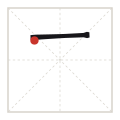
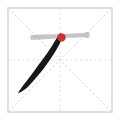
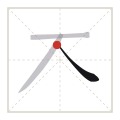
The wave: 一波三折
Classical descriptions call the 捺 a single wave with three folds, and the phrase is a description of pressure rather than of shape. The stroke enters almost like a hairline, swells through the middle, reaches its heaviest point at the foot, and then releases into a flat exit.
The three folds are the two changes of direction plus the press: the light entry, the long diagonal swell, and the near-horizontal exit. Written with even pressure the same outline becomes a slide, and the character reads as if it is leaning backwards.
Pressure and geometry, stroke by stroke
The plate on this page is generated from the numbers below. Widths are in drawing units against a 120-unit box; the character is 大.
| Point along the stroke | Width (units) | What the brush is doing |
|---|---|---|
| 0 % (entry) | 0.9 | set down light, right below the 横/撇 crossing |
| 30 % | 2.6 | accelerating, tip still centred |
| 62 % | 6.2 | the swell begins |
| 82 % | 8.4 | the foot — heaviest point of the whole character |
| 92 % | 5.0 | release begins, direction turns flat |
| 100 % (exit) | 1.0 | thin horizontal exit, brush leaving the paper |
Where the 捺 meets the 撇
In 大 the 捺 starts from the upper part of the 撇, not from the 横. The crossing point sits roughly one third of the way down the 撇 and slightly right of the character's axis. Starting the 捺 too high makes the character top-heavy; starting it too low leaves the upper right corner empty.
The 捺 should also end at the same level as — or a hair above — the foot of the 撇. A 捺 that finishes lower than the 撇 pulls the whole character down to the right.
Three faults, and the fix for each
- Flat 捺: constant width all the way down. Fix by exaggerating the foot press for one page, then dialling back.
- Hooked exit: the exit curls upward because the brush was lifted too early. Keep the heel of the hand down until the tip has left the paper.
- Pointed foot: the press was skipped entirely, which usually means the writer is moving faster than the brush can load.

Printable A4, drawn to the worksheet specification — print at 100 % and check one cell with a ruler.
Takeaways
- The 捺 is defined by a pressure curve, not by an outline — the foot is the heaviest point in the character.
- Entry is a hairline; the exit is nearly horizontal.
- In 大, the 捺 starts about one third down the 撇, not at the 横.
- The 捺 never finishes below the foot of the 撇.