
Regular script · Glyph · Published 2026-09-25 · By The Lettering Desk
The shù gōu 竖钩 in 水: where the vertical stops and the hook starts
The hook is the single stroke that separates competent regular script from student regular script. Almost every beginner draws the vertical first and then bolts a hook onto the bottom of it; a real 竖钩 is one continuous motion in which the vertical decelerates and the hook is thrown out of that deceleration. 水 is the cleanest place to learn it.
- Glyph
- 水 — Shù gōu — vertical with a hook
- Hand
- Regular script
- x-height
- —
- Nib / brush angle
- 竖画垂直;趯出方向约左上 45°,钩身长约竖宽的 40%
- Tool
- 兼毫中楷,出锋长度约 6 mm
- Stroke order
- 竖钩 → 横撇 → 撇 → 捺(4 strokes)
Stroke sequence
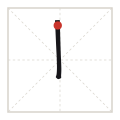
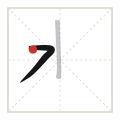
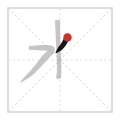
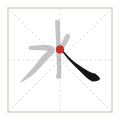
One stroke, not two
A 竖钩 carries three distinct phases inside a single stroke: the set-down, the descent, and the 趯 (tì) or kick. The mistake is to treat the kick as a separate movement. If you stop at the bottom of the vertical, aim, and then push out a hook, the joint shows a knot and the hook points sideways instead of up.
The correct sequence is a slow-down rather than a stop. Travel down at speed, decelerate through the last fifth of the vertical, press straight down to seat the tip, then release the pressure outward and up. The hook is the brush recovering, not a new stroke being added.
Where the hook actually goes
In 水 the vertical sits on the axis of the character and the hook kicks to the upper left at roughly 45°, ending at about the same height as the point where the 横撇 crosses the vertical. Direction matters more than length: a hook that leaves at 20° reads as a slip, one that leaves at 70° reads as a second stroke.
Length runs about 40 % of the width of the vertical at its thickest. The tip must come out sharp; if the end is blunt, you pushed the brush instead of releasing it.
| Phase | Share of stroke length | Brush pressure | Common fault |
|---|---|---|---|
| Set-down 起笔 | first 8 % | medium, hidden entry | pointed head |
| Descent 行笔 | 8 % → 80 % | even, centre tip | drift off the vertical |
| Seat 驻笔 | 80 % → 92 % | heaviest point | no press at all |
| Kick 趯 | last 8 % | released, accelerating | hook drawn sideways |
The other three strokes of 水
水 is a four-stroke character and each of the remaining strokes answers the hook:
- 横撇 starts at the left, runs right to about the character's midline, then folds back down-left. The fold is a turn, not a corner — the brush does not lift.
- 撇 is short and starts high on the right of the vertical, sweeping down-left and stopping before it reaches the vertical. This is the 啄 of 永字八法.
- 捺 crosses the vertical low, swells to its widest about 80 % of the way along, then presses and exits almost horizontally to the right.
Drill
Fill one sheet of 26 mm 米字格 with nothing but 竖钩, twelve per row, and vary only the kick direction — 30°, 45°, 60°. Then write 水 twelve times and compare the hook against the height of the 横撇 fold; they should end at approximately the same level.

Printable A4, drawn to the worksheet specification — print at 100 % and check one cell with a ruler.
Takeaways
- The hook is thrown out of the deceleration of the vertical, never added afterwards.
- Kick direction ≈ 45° up-left; wrong direction is a worse fault than wrong length.
- Hook length ≈ 40 % of the vertical's maximum width.
- In 水, the hook tip and the 横撇 fold sit at about the same height.