
Running script · Glyph · Published 2026-09-16 · By The Lettering Desk
之 in running script: what the 牵丝 is allowed to carry
之 is three strokes in regular script and looks like one gesture in running script — but the change is not simply speed. Running script adds a filament (牵丝) between strokes that must be thinner than any real stroke, and 之 is the shortest possible place to learn where that filament belongs and where it does not.
- Glyph
- 之 — Zhī — the character 之 in running script
- Hand
- Running script
- x-height
- —
- Nib / brush angle
- 转折圆转,运笔主轴在 ±6° 内摆动
- Tool
- 兼毫小楷或狼毫,出锋约 4 mm
- Stroke order
- 点 → 横撇 → 捺 → 牵丝(4 strokes)
Stroke sequence

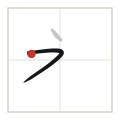
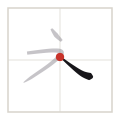
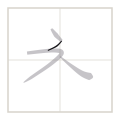
The filament rule
A 牵丝 is the mark left by the brush travelling between two strokes without lifting. It is a trace, not a stroke, and it must stay under roughly half the width of the thinnest real stroke in the character. Once a filament reaches stroke weight the character stops being running script and becomes regular script written carelessly.
The practical test is to cover the filaments and read the character: if it is still 之, the filaments are doing their job. If removing them destroys the structure, they have been used as structural strokes, which is the single most common failure in beginner running script.
How 之 actually moves
Four marks appear in the running-script form, and only three of them are strokes:
| Mark | Weight | Where it points | Function |
|---|---|---|---|
| 点 (the dot) | heaviest of the head group | down-right, into the turn | sets the axis of the whole character |
| 横撇 | medium, thinning at the fold | right, then folding back to the lower left | carries the character's width |
| 捺 | swells to the foot, exits with a returning tip | down-right, flattening | carries the weight |
| 牵丝 | under half of the 横撇 width | from the dot into the fold | trace only — never load-bearing |
Where the fold goes
The fold in 横撇 is the hinge of the character. In regular script it is a turn with a visible shoulder; in running script the shoulder is rounded off completely and the brush loses almost no speed through it. Keep the radius of the turn around one third of the character's width — a tighter turn looks cramped, a wider one turns 之 into a 乙 shape.
The 捺 then starts from the inside of that turn rather than from the fold itself. This is what produces the characteristic compressed look of running-script 之: everything above the 捺 is packed into the upper two thirds.
Four ways 之 fails
- Filament at full stroke weight: the trace becomes a stroke and the character flattens into regular script.
- Broken trace: the brush is lifted between the dot and the 横撇, so the connection reads as a gap.
- Over-long 捺: running-script 之 keeps the 捺 shorter than in regular script; letting it run to the grid edge makes the character sprawl.
- Rounded dot: the opening dot must still have a clear head and a direction; making it a plain blob removes the axis.
Takeaways
- A 牵丝 must stay under half the width of the thinnest real stroke.
- Cover the filaments and read the character — that is the test.
- Round the fold completely; radius ≈ one third of the character width.
- The 捺 starts inside the turn, not at the fold.