
Running script · Glyph · Published 2026-10-04 · By The Lettering Desk
The three-dot water radical in running script: two strokes, one gesture
In regular script 氵 is three separate marks. Running script reduces it to two — the second and third dots fuse into a single stroke that ends in the rising 提 — and the radical then hands its energy to the right-hand component through the tip of that rise. 江 is the standard demonstration: the left radical and 工 are joined by a single contact point.
- Glyph
- 江 — Sān diǎn shuǐ — the three-dot water radical
- Hand
- Running script
- x-height
- —
- Nib / brush angle
- 提的锋尖上挑约 25°,直接搭进右部横画的起笔
- Tool
- 兼毫小楷,出锋约 4 mm
- Stroke order
- 上点 → 中·下点连写 → 提(牵丝入工) → 横 → 竖 → 横(6 strokes)
Stroke sequence
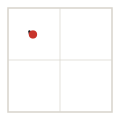
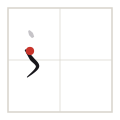
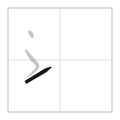
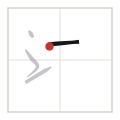
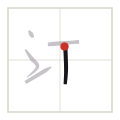
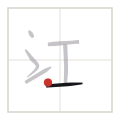
Why the dots fuse
Three marks of the same kind, close together, moving in the same direction, are the clearest possible case for fusion in running script. The middle dot keeps its dot *shape* at the top of the fused stroke and the bottom of the stroke turns into the 提, so a reader still counts three elements even though the brush set down twice.
The fusion is not a shortcut for speed. It exists because the 提 that follows pulls the middle dot out of vertical alignment: in running script all three marks lean toward the right-hand component instead of hanging straight.
The contact point is the whole trick
The 提 leaves the radical rising at roughly 25° and its tip lands exactly where the first horizontal of 工 begins. That single contact point is what makes the character read as one unit. Written with a gap of even two millimetres at 26 mm grid size, 江 splits into two characters sitting next to each other.
The contact must be a touch, not a join. The tip of the 提 stops at the head of the horizontal; if you continue through and merge the two strokes, the left radical visually swallows the right component.
| Element | Relative width | Start | End |
|---|---|---|---|
| Top dot | 1.0 | upper left, x ≈ 24 | x ≈ 29, pointing down-right |
| Fused middle + bottom | 1.1 at the dot, 0.8 at the exit | x ≈ 20 | x ≈ 34, at the 提 tip |
| 提 tip contact | tapering to a point | x ≈ 34 | x ≈ 50 (the 工 horizontal head) |
| 工 horizontal | 1.0 | x ≈ 46 | x ≈ 82, shorter than in regular script |
What the right-hand component gives back
工 in running script is compressed: the top horizontal is shorter than in regular script, the vertical carries a slight belly to the left, and the bottom horizontal finishes with a small upward lift that connects to nothing. That unconnected lift is deliberate — it is the visual echo of the contact point on the left, and it balances the character.
Practice sequence for 氵
- Write the fused middle-and-bottom stroke forty times on its own, checking that the dot shape survives at the top.
- Draw the 提 tip to the head of a horizontal, touching but not merging, twenty times.
- Write 江 twelve times at 28 mm, then twelve times at 14 mm; the contact point is the first thing to fail when the grid shrinks.
- Finish on 河 and 湖 and check whether the same contact point still holds with taller right-hand components.

Printable A4, drawn to the worksheet specification — print at 100 % and check one cell with a ruler.
Takeaways
- Running-script 氵 is two brush set-downs, not three strokes.
- The 提 tip must touch — not merge with — the right component's first horizontal.
- All three marks lean toward the right-hand component.
- 工's final upward lift is an echo of the contact point; leave it unconnected.